Posts

Showing posts with the label Finance

Xero's Top Features: A Guide to Help You Decide if Xero is Good for Your Business

Image
When it comes to choosing the right accounting software for your business, you need to make sure that the product you choose is good for your needs. That's why it's important to ask yourself: Is Xero good for my business? In this blog post, we'll take a look at some of the best features of Xero accounting software and help you decide if it's the right fit for you. Ease of Use One of the standout features of Xero accounting software is its ease of use. Designed with small business owners in mind, Xero's intuitive user interface allows for efficient and seamless financial management. With no accounting jargon or confusing menus, even those without accounting experience can navigate the software with ease.  Navigating the dashboard is a breeze, with clear and concise financial summaries that give you an overview of your business's financial health. The software's drag-and-drop functionality also allows for easy data input, so you can quickly and accurately keep...

What is a hire purchase agreement?

Image
Hire purchase agreements are a type of credit, most commonly used by people to purchase goods such as cars, or large household appliances. Under a hire purchase agreement , the creditor remains the legal owner of the goods until you have repaid the sums due under the agreement .

What is Capital Control?

Image
For those of you that are wondering about the recent news headlines, here is a brief explanation. I do hope that the Greeks can find a solution to their problems soon.

Upcoming Challenges for Retail Banks

Image
There is a genuine sense that our high street big banks are about to enter a new era (unwittingly for some) where the old and tested retail banking model is due for a dramatic (and painful) shake-up. Sadly, this comes just as our banks are about to recover from the recent financial crisis, and many see traditional prudent retail banking as the way forward. Peer-to-peer lending  is coming. I came across this term recently and was shocked (in a good way) by this idea. It is very simple: peer-to-peer lending matches people with money to those who need it, bypassing the bank altogether. And because the bank is not involved, the rates for both the lender and the borrower can be better than they can get from the bank.   This is a brilliant idea, enabled by the Internet age. Only now can we seamlessly match lenders and borrowers in the masses efficiently, quickly and (safely?). And in case you haven't noticed, the idea is based on  not  having the banks involved. A s...

Investments and UK Tax

Image
Note: Please be aware that this article was written in 2014. It's best to check the latest tax rates and rules on the .gov.uk website as rules do change every year. The uswitch website has a very nice summary on tax and investments. You can view the original web page here . Chances are that you are affected by tax from investments if you have at least one of the following (although this is by no means a complete list): 1. Interest from savings . 2. Income from a pension. 3. Rental income. 4. Dividends from shares. 5. Capital gain from the sale of shares or property. An exception to these tax rules is dividends or gains within an ISA, which are tax-free. Interest from savings  will have basic rate tax taken off at source (20% tax deducted at source), so you don't need to pay any additional tax unless you pay a higher rate income tax. For other income and capital gains, you will need to declare them by filing a Personal Tax Return every year. 2024 Update: I...

Upcoming UK Dividend Payment Dates

Image
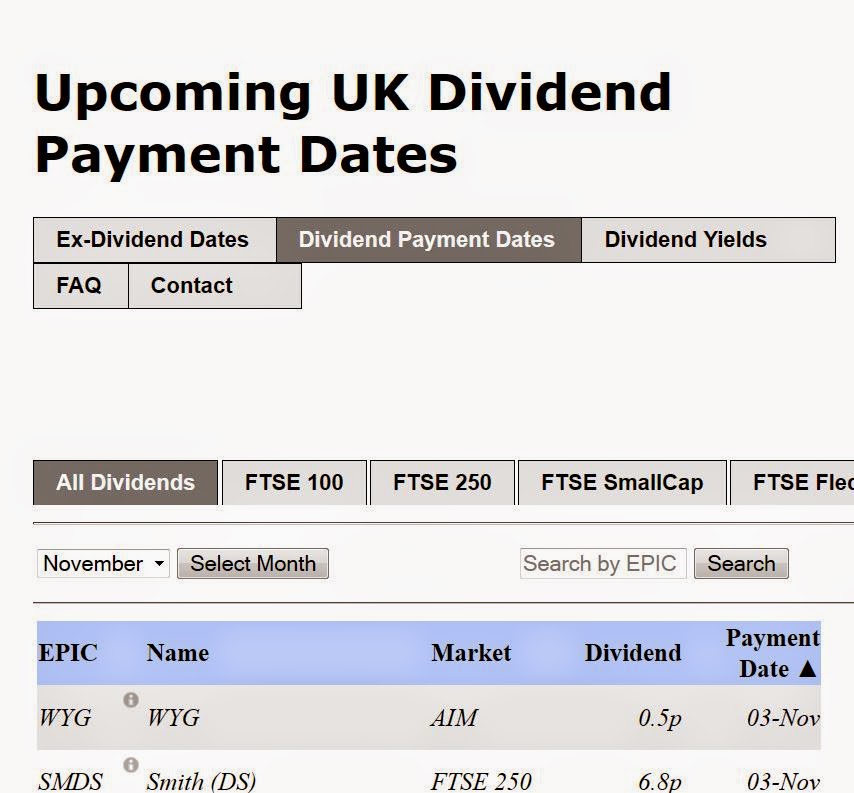
Just to share with you all a very handy website that lists all upcoming dividend dates for all different UK share indices. I find that this is easier than checking individual company websites. One of the table also shows the current dividend yields, which can be quite interesting to browse through from time to time.

Buying US Shares from the UK

Image
Have you ever thought about owning shares of those mighty US corporate giants, such as Microsoft, Cisco, or Apple and benefit from their global success? (well, provided that you get them at a good price..). If you are British and live in the UK, it is actually quite easy to do. Simply call your stock broker and ask to activate your dealing account for US trading. You will be asked to fill in an Individual Investor declaration form which takes about 10 minutes (asking questions such as status of employment, do you trade professionally or for a company...etc.). The form is renewed annually to keep the record up-to-date.  And.. that is it really, you are ready to go. Bear in mind that there are also currency exchange and tax considerations to think about. As a foreign person, your stock broker can also provide you with a Form W-8BEN , to reduce the amount of withholding tax that you are required to pay if you receive any dividends. Here are more advices from the Tel...

Fiscal/ financial year of a company

Image
A friend told me today that their company's financial year starts and end in October. He reassured me this is actually quite common (is it?), I am not quite convinced. There are obvious reasons why most would choose April to be the month to end the financial year as many new tax changes introduced by the government starts from the government's own start of the fiscal year, which is at the beginning of April. Otherwise, companies may need to incorporate new tax changes half way through the financial year. There too are obvious reasons why the end of December would be a bad choice (unless your accounting staffs enjoy the thrill of having big Christmas deadlines every year!). However, after doing some quick searches online, the exact date doesn't seem to matter a great deal (at least in the UK), it seems to depend on when the company was formed. There are some considerations as to when the corporation tax is due and the company's cash flow through out the year...

Non-residence, Tax and Money

So resently a friend working abroad mentioned about his tax situation. It sounded rather complicated so I decided to help to see if we can make more sense of it. As usual, all the information is on the HMRC website , the trouble is to digest them all..   Non-resident & Not Ordinarily resident : Non-resident : You'll be treated as non-resident from the day after you leave the UK if you can show: you left the UK to go abroad permanently or your absence and full-time work abroad lasts at least the whole tax year your visits to the UK are less than 183 days in a tax year and average less than 91 days a tax year over a maximum of four consecutive years   Not ordinarily resident : You normally live outside the UK. Forms :  If you have left or are about to leave the UK you must tell HM Revenue & Customs (HMRC). If you're not required to fill in a tax return , you'll have to complete form P85 Leaving the UK - getting your tax right. ...